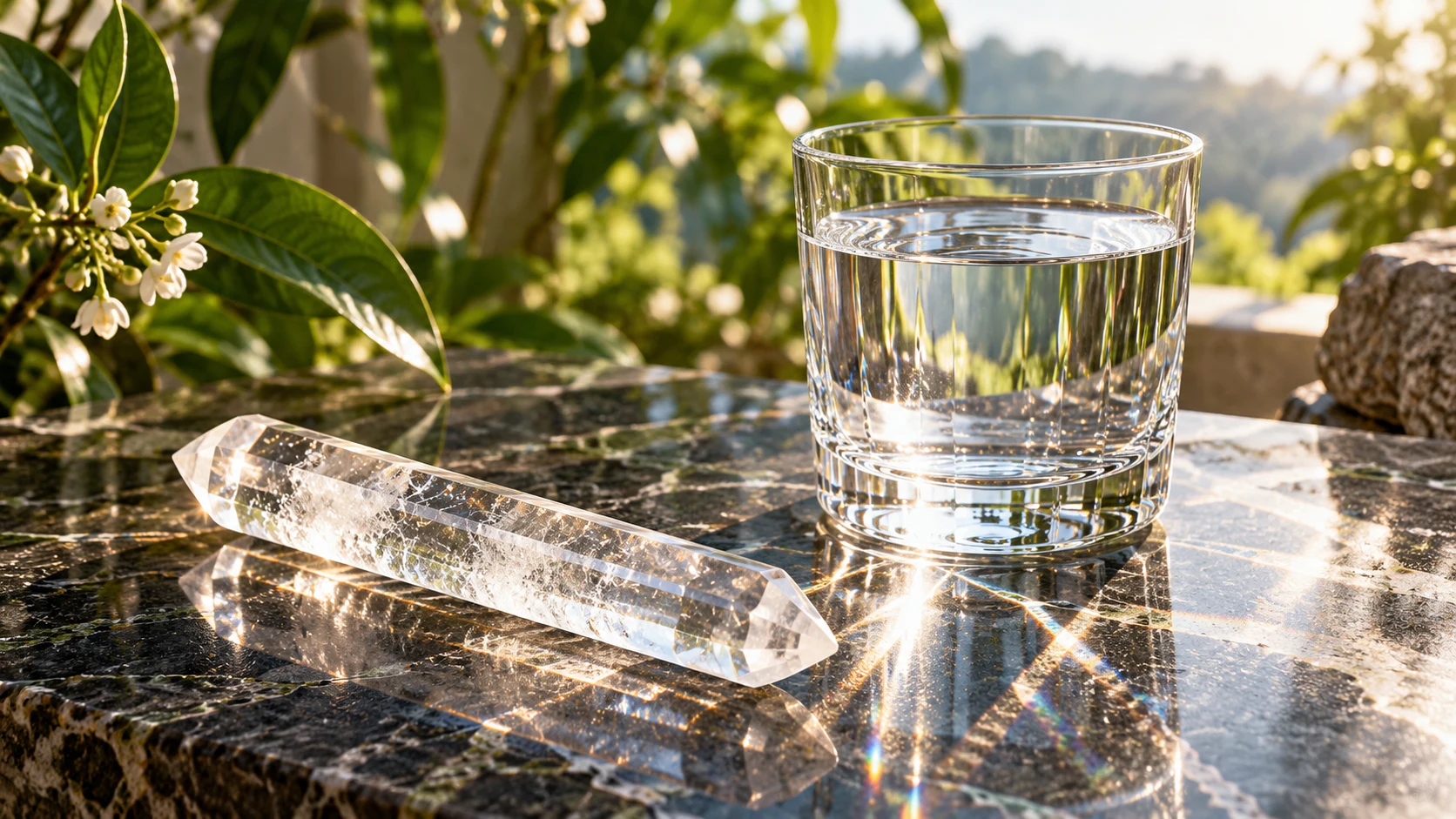
A glass of water should be the simplest object in the room. Transparent, familiar, almost invisible in daily life. Add a slender quartz wand and it becomes the centre of a much larger proposition: that the arrangement of water can be changed, that the change persists, and that drinking it can alter biology. The appeal is easy to understand. An ordinary routine might become an intervention without adding another pill.
Aǹalemma deserves a specific investigation rather than a reflexive reaction. Its supplier has made research reports available, including controlled human comparisons. That is more useful than testimonials alone. The challenge is deciding what those reports actually establish. A measurement in blood, a microbiome score and a proposed property of water occupy different parts of the argument. They cannot quietly stand in for one another.
Our present assessment is that this remains an early, commercially developed hypothesis. The material reviewed here does not establish a health benefit or independently demonstrate the proposed mechanism. The interesting work begins with the distinctions, because a fair test needs an outcome that could also disprove the claim.
The proposition inside the wand
The supplier's explanation describes proprietary Mother Water sealed inside a quartz vial and proposes that its coherent state can be transferred to surrounding drinking water. It says the product does not filter water or change its chemical content. Its FAQ also describes germinating seeds' light emissions as an indirect assay and acknowledges reproducibility limitations in conventional spectroscopic approaches used for quality assurance. These are company statements, not an independently verified account of the mechanism.
That distinction tells us where to start. In our editorial interpretation, a test of plant behaviour is a test of a biological response under specified conditions. Calling it a measure of water coherence adds another inference. To validate that inference, researchers would need to show how reliably the assay identifies the proposed property, how it excludes ordinary differences between samples and how another laboratory can reproduce the result.
The question is not whether water can have interesting physical behaviour. It is whether this particular procedure creates the particular persistent change being advertised. A broad scientific idea does not validate every device built around its vocabulary. We would ask for a clear operational definition: what exactly is the quantity, what instrument measures it, and what result counts as unchanged water?
Following the ATP headline back to the report
The company's ATP page presents a 38-participant, two-month comparison and a claimed 20% advantage over placebo. The linked original supplier-hosted report describes 50 people across three groups: 13 assigned Aǹalemma water, 12 another test water and 25 placebo. Thus 38 is the total for the Aǹalemma-versus-placebo comparison, rather than the complete experiment. It measured whole-blood ATP at baseline and day 60; other sections describe a 90-day treatment schedule. That reporting inconsistency warrants clarification.
The result deserves its narrow description: a reported difference in a blood laboratory measurement. It does not directly show greater stamina, less fatigue, longer life or better brain function. Those would require outcomes designed to answer those questions. We would not translate the advertising percentage into a percentage increase in a person's usable energy.
Our methodological interpretation is straightforward. A quantity measured in a blood sample is not automatically a measure of the energy-making capacity of every tissue. The assay, sample processing and denominator all matter. Before using a result to support a performance claim, we would want the report to connect the measurement with a validated performance outcome in the same trial.
Why the comparison matters more than the uplift
Imagine a future trial in which both groups improve after being asked to drink water regularly. The product group improves slightly more. That difference might be meaningful, negligible or a chance finding, depending on its size and uncertainty. Advertising only the improvement in the product group would conceal the essential comparison. Reporting the between-group estimate and its confidence interval would make the result more informative.
This is an illustrative example, not a description of an additional Aǹalemma experiment. It explains what we would examine in a decisive replication: the prespecified comparison, complete group data, handling of missing samples and variation between participants. We would also ask whether the analysis plan preceded access to results. An attractive finding is more persuasive when the researchers committed to the question before knowing the answer.
The same discipline applies to safety. A short study of selected adults cannot establish lifetime safety, safety in every illness or the absence of rare events. Nor does an absence of reported harm demonstrate a benefit. The evidence has to match the time frame and population of the proposed use.
Sixteen people and a microbiome score
A separate supplier-hosted microbiome report describes eight people per group, assigned active or placebo wands, consuming at least 1.5 litres daily for about 100 days. Stool samples were compared before and after. The report's headline difference combines a 10.7% improvement in its dysbiosis index in the active group with a 5.3% worsening in placebo. The supplier's web summary describes this as a 16% improvement over placebo.
This is an exploratory signal in a very small sample. It is not evidence that the product prevents diabetes, improves mood or treats a digestive disorder. Those outcomes were not established by the comparison described. A change in a composite score needs its own interpretation before it becomes a claim about health.
Our interpretation is that a useful follow-up would report individual trajectories and uncertainty around the group difference. With eight people per arm, one unusual response can matter substantially. A larger trial should also document diet, medicines, recent illness and other exposures that could complicate interpretation, rather than treating an instruction to keep lifestyle stable as proof that everything remained identical.
What a biomarker can—and cannot—carry
The FDA's explanation of biomarkers provides an important general distinction. A measured biological characteristic can indicate a response without being a validated substitute for how a person feels, functions or survives. This is methodological context, not an FDA assessment of Aǹalemma.
Applied here, our interpretation is that ATP and a microbiome index are leads for investigation. They are not interchangeable with improved wellbeing. Even a repeatable change might have an uncertain clinical meaning. A responsible report would keep the measured result visible and leave the larger health claim open until it has been tested directly.
There are also two separate causal questions. Did the assigned procedure cause the measured response? And was the supplier's proposed coherence mechanism responsible? A successful human comparison could strengthen the first question without resolving the second. Mechanisms need evidence rather than being awarded automatically to the explanation printed on the box.
The physical experiment we would commission
Our proposed test would begin with coded samples from multiple batches and a matched sham wand. The water source, vessel, temperature, handling and time since treatment would be controlled. Laboratories would specify the physical endpoint and acceptable measurement error before decoding the samples. They would include untouched water and sham-stirred water so that stirring alone could be distinguished from an active-device effect.
A useful design would then test whether independent teams could identify treated samples better than chance using the same protocol. All results would be published, including failures and ambiguous batches. Repeating only the most favourable run would defeat the purpose. If the proposed property lasts, the experiment should state how persistence will be assessed and what loss of the signal would mean.
These are editorial proposals for stronger research, not experiments that we claim have been completed. They also show why beautiful photographs are insufficient. An image becomes evidence when its acquisition, selection and scoring are controlled, and when the method predicts the right answer on samples the operator cannot identify.
Then comes the human question
After a physical result is reproducible, a human trial should choose one main benefit rather than a long list of possibilities. A fatigue claim might require a validated fatigue measure in a defined population. An exercise claim would need a prespecified performance test. The design should state in advance what improvement would be large enough to matter to the intended user.
We would favour a credible placebo, allocation concealment, an assessment of whether blinding worked and independent statistical analysis. Both groups should receive the same contact and instructions. A completed trial should report withdrawals, adherence and adverse events as carefully as favourable outcomes. The protocol and analysis code should allow another team to attempt a genuine replication.
Commercial involvement need not invalidate an experiment. It should be visible. Who commissioned the work, supplied the devices, held the data and decided whether to publish? A separate laboratory performing a commissioned test is different from an independent group choosing the research question and reproducing it without the supplier controlling publication.
The decision at the kitchen bench
For a reader, the most useful question is what decision the evidence supports today. It supports reading a hypothesis and examining small exploratory studies. It does not support relying on the wand to treat illness or buying it on the assumption that a blood-marker result guarantees greater vitality. Safe drinking water remains the starting requirement; a device explicitly described as non-filtering cannot be treated as a purification method.
If someone chooses to buy it as a personal curiosity, the uncertainty should remain part of the purchase. A diary of feeling better can be personally interesting, but it will not isolate the device from expectation, hydration, changing routines or normal variation. Personal experience and controlled evidence answer different questions.
We would change our assessment with transparent replication of a defined physical effect and appropriately controlled human evidence of a meaningful benefit. Until then, the strongest story is the experiment still needed. Wonder earns its place in science by becoming a question clear enough for reality to answer.
Read beyond the headline.
- Aǹalemma technology explanation and FAQ — Supplier claims
- Aǹalemma ATP study summary — Supplier summary
- Original Aǹalemma ATP report — Supplier-hosted original report
- Original Aǹalemma microbiome report — Supplier-hosted original report
- Microbiome study summary — Supplier summary
- FDA biomarkers and surrogate endpoints — Official methodological guidance
Original sources and their evidence roles are listed above. Supplier reports are identified separately from independent research. Sources were checked for this expanded editorial edition; access limitations are recorded in the feature audit.