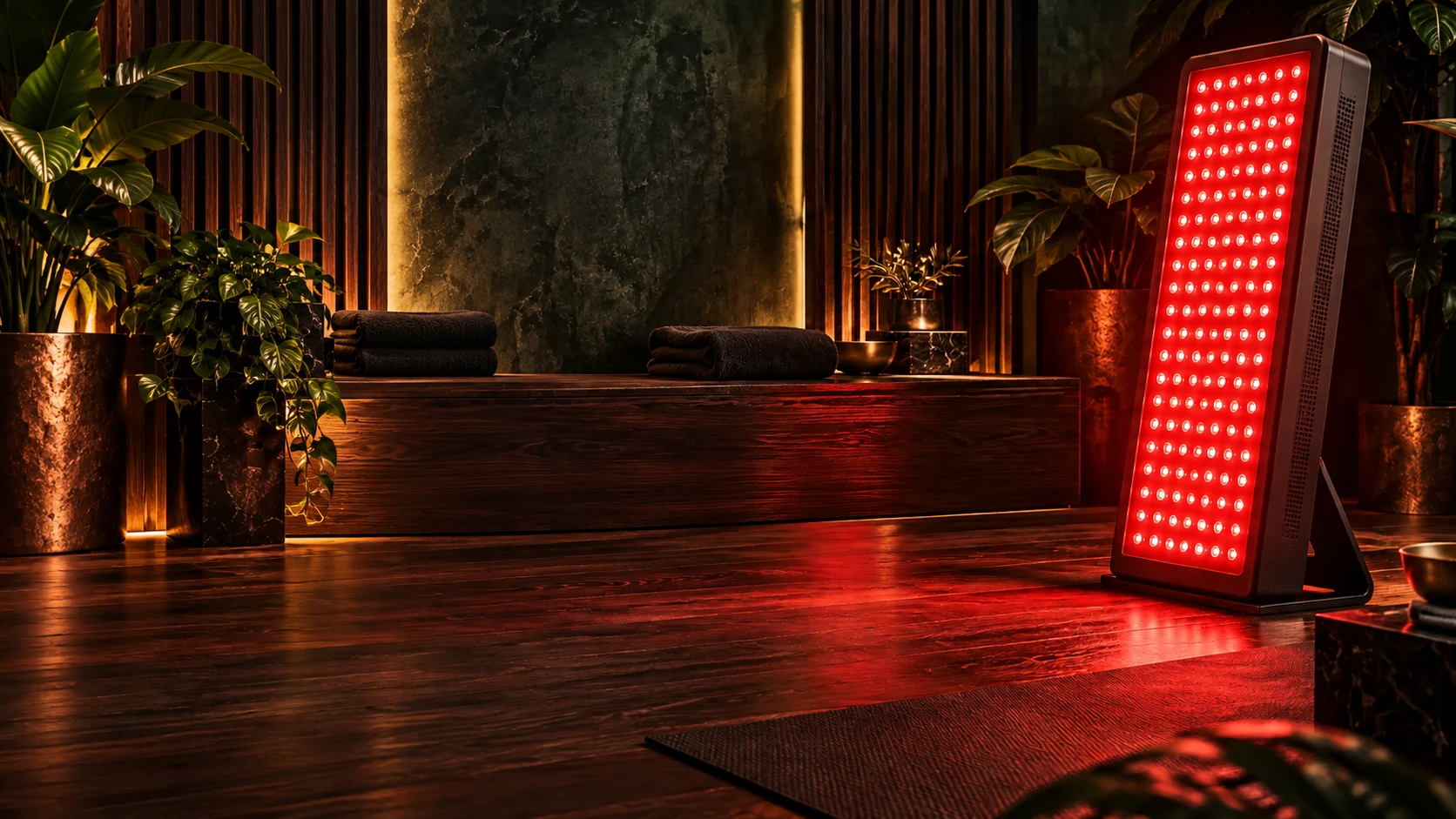
The glow is unmistakable. A red panel beside a gym bench. A mask on a bedside table. A treatment room lit like the closing scene of a science-fiction film. Red light has become one of wellness culture's most recognisable images, carrying an unusually broad promise: better skin, faster recovery, less pain and, sometimes, a more youthful body from the inside out.
There is real science behind parts of that picture. Photobiomodulation, the use of light to influence biological processes without deliberately destroying tissue, has been studied in human trials for decades. But the picture conceals a problem. A colour is not a treatment protocol. Research on a precisely delivered laser in a clinic cannot automatically validate a whole-body panel in a living room. The crucial information sits behind the glow.
A treatment is more than a wavelength
Visible red and invisible near-infrared light occupy different parts of the spectrum. Researchers select wavelengths partly because absorption and penetration vary with light and tissue. They also control how much power reaches an area, for how long, at what distance and on what schedule. Those variables determine exposure. The number of LEDs in a photograph tells a consumer very little about them.
A useful comparison is a medicine label stripped of its dose. Naming a wavelength while omitting delivered energy leaves a similar gap. Even matching wavelength and energy at the surface does not ensure that the same amount reaches a deeper target. Contact, beam geometry, tissue composition and the body site complicate the translation. A scalp device, facial mask and knee-treatment laser are not interchangeable versions of one established intervention.
The FDA's draft guidance for photobiomodulation devices addresses testing, clinical studies and labelling for particular intended uses. Its existence reflects a serious medical-device field. It also illustrates why device-specific evidence matters. A general reference to photobiomodulation cannot replace documentation of what a particular product delivers and what it has been tested to do.
The skin evidence is more substantial than a testimonial
One frequently cited 2007 randomised, sham-controlled study enrolled 76 people with facial wrinkles. Participants received 633-nanometre light, 830-nanometre light, their combination or sham treatment to one half of the face, twice weekly for four weeks, with three months of follow-up. The investigators combined photography and skin measurements with tissue examinations.
The active groups showed improvements in wrinkle and elasticity measurements, alongside changes consistent with increased collagen and elastic fibres. This is stronger evidence than a flattering before-and-after photograph because it includes controlled comparisons and objective investigation. It is still a particular set of devices and settings in a modest-sized population. The largest reported within-group improvement is not the average effect a buyer should expect from any red mask.
A 2014 controlled study involving 136 volunteers investigated broader-area red and near-infrared light treatments. Participants underwent repeated sessions, and the researchers assessed skin feeling, complexion, roughness and collagen-related measurements. They reported favourable changes in treated groups. The apparatus and spectra were specific, and the control was not equivalent to a modern, convincing sham for every participant.
That study supports further interest in skin applications, rather than a guarantee that a retail device reproduces its findings. Subjective satisfaction and instrument measurements answer related but different questions. A change visible to a measurement system can be real while appearing subtle in daily life. Cosmetic value is partly personal, making realistic photographs and clearly described outcomes more useful than a universal promise of rejuvenation.
More light studies do not equal one universal result
A 2007 clinical study from Sydney investigated combined 633- and 830-nanometre LED treatment for photoaged skin. Its treatment schedule and fluences belonged to a clinical protocol. It adds to the history of human skin research, but it does not validate every product that advertises those two wavelengths. Delivering the same colours is only one part of delivering the same intervention.
Another study of combined 633- and 830-nanometre treatment examined photoageing with its own devices and assessment methods. Studies such as these help explain why the category has persisted. They also show why a purchaser needs to ask for the complete paper rather than accept a list of citations whose populations, settings and products may be different.
Our reading is that selected skin outcomes are a credible area of interest, with benefits that should be described as protocol-dependent and potentially modest. These trials do not establish that red light replaces sun protection, diagnoses a changing skin lesion or reverses ageing throughout the body. A healthier-looking surface and a longer life are distinct propositions requiring distinct evidence.
Pain trials ask a different clinical question
Knee osteoarthritis illustrates how complicated the comparison becomes. A 2018 randomised study compared exercise alone, exercise with active phototherapy and exercise with placebo phototherapy. The active intervention used a cluster containing a 905-nanometre laser and LEDs at 875 and 640 nanometres. It was applied locally with a specified energy per session.
The design asks what light adds to an exercise programme. It does not ask whether standing in front of a consumer panel replaces rehabilitation. That distinction deserves to remain visible even when an abstract reports favourable outcomes. A clinician also needs to know whether pain, physical function or another measurement improved, how much it improved and whether the advantage lasted.
A 2022 placebo-controlled trial enrolled fifty people with knee osteoarthritis and followed a combination of local low-level laser therapy and strength training. Investigators assessed outcomes over a year. The findings were mixed across measures, with selected advantages such as reduced analgesic use and better sit-to-stand performance rather than a clear improvement on every endpoint.
That is a useful corrective to the language of a single winning technology. A treatment may help one aspect of function and leave another unchanged. Rehabilitation studies also involve repeated attention, exercise and expectations. A credible sham and a consistent programme help isolate the contribution of light. A testimonial from someone who simultaneously began exercising cannot do the same job.
Recovery is not established by a change in soreness alone
The gym setting makes an appealing commercial bridge from clinical phototherapy to everyday performance. But research findings do not uniformly support broad recovery claims. In a randomised crossover study of twelve trained men, a whole-body light bed was used around a high-intensity exercise session. The investigators measured creatine kinase and salivary interleukin-6 after exercise.
The intervention did not significantly improve those markers compared with the control condition. The study was small, and its design lacked a convincing whole-body sham, so it cannot settle the category. It does provide a direct reason to resist claims that whole-body light reliably reduces exercise-related muscle damage or inflammation. The investigators' negative findings belong beside the positive ones.
A separate placebo-controlled training trial recruited 39 healthy young men and found no additional benefit from photobiomodulation during the exercise-training programme studied. Together these experiments suggest the relevant question is not whether light works in principle. It is whether a particular protocol adds a meaningful advantage for a particular athlete under particular training conditions.
For consumers, soreness, biochemical markers and next-session performance should remain separate. Feeling more recovered can matter, but it does not prove improved tissue repair. A lower marker does not automatically mean better performance either. Studies should specify their primary outcome in advance, rather than invite readers to choose whichever measurement makes the device look most successful.
A hospital application should not become a home-panel claim
One of the clearest examples of a legitimate medical research programme concerns oral mucositis, the painful inflammation that can occur during cancer treatment. A phase III, double-blind trial in 94 head-and-neck cancer patients tested preventive low-level laser treatment during concurrent chemoradiation. It reported benefits in severe mucositis and related outcomes under a specialised protocol.
That does not mean red light treats cancer. The target was a complication of treatment, managed in a clinical setting. The distinction is indispensable: a supportive-care application cannot be repackaged as evidence that illuminating a tumour or using a home panel is beneficial. People undergoing cancer treatment should discuss light-based interventions with their oncology team.
The UK LiTEFORM trial investigated a different practical protocol for mucositis during head-and-neck radiotherapy. Recruitment fell short of the planned sample, limiting the conclusions that could be drawn. It also documented delivery and service challenges. Clinical usefulness depends on whether an intervention can be delivered reliably, not only on whether a biological rationale sounds convincing.
Read the safety instructions as part of the science
Photobiomodulation is generally intended to use non-destructive light exposures, but that description is not a blanket safety guarantee. Intensity, wavelength, eye exposure, heat, treatment site and individual circumstances matter. A device designed for one purpose should not be improvised for another. Near-infrared light can be invisible; comfort and brightness are poor instruments for judging the exposure.
Use the protection and restrictions specified for the actual device. Photosensitivity, relevant medicines, eye disease and suspicious skin lesions are reasons to seek professional advice before use. Stop an experiment that causes pain, persistent irritation or visual symptoms. More time and a shorter distance do not automatically produce more benefit; they change the dose and can undermine the safety assumptions behind the instructions.
This is also why we would not publish one universal distance or session duration for all panels. A numerical instruction feels helpful but becomes misleading when power, optics and intended use differ. The honest practical guidance is to match a tested protocol and the product's instructions, rather than create a dosage from a photograph or social-media routine.
The questions worth asking before buying
A serious seller should be able to identify the intended outcome, the exact model, delivered irradiance at the stated distance and a relevant human study. Ask whether the study tested that product, a materially comparable device or simply the wider category. Ask whether the comparison used a sham, whether assessment was blinded and whether the reported improvement was large enough to matter.
Check the actual Australian regulatory status where therapeutic claims are made. A foreign clearance, a laboratory certificate and an Australian Register of Therapeutic Goods entry answer different questions. None should be translated into a promise of whole-body rejuvenation. Warranty, replacement costs, realistic adherence and the value of the targeted outcome belong in the purchase decision too.
The strongest conclusion is precise enough to be useful. Red and near-infrared light have credible, developing roles in selected clinical and cosmetic settings. Benefits depend on indication and protocol; results are not uniformly positive. The next advance will come from matching those details more reliably, not from making the room redder or the advertising louder. The glow can invite curiosity. The evidence has to decide what follows.
Read beyond the headline.
- FDA photobiomodulation draft device guidance — Regulator draft guidance
- Lee et al., split-face skin trial — Randomised trial
- Wunsch and Matuschka, red/near infrared skin trial — Controlled clinical study
- Baez and Reilly, photoaged skin — Clinical study
- Combined 633 and 830 nm skin treatment — Clinical trial
- Exercise and active or placebo phototherapy in knee osteoarthritis — Randomised trial
- Stausholm et al., knee osteoarthritis and strength training — Randomised trial
- Ghigiarelli et al., whole-body recovery study — Randomised crossover study
- Photobiomodulation during exercise training — Randomised placebo-controlled trial
- Antunes et al., mucositis prevention — Phase III randomised trial
- LiTEFORM trial — Multicentre randomised trial
Original sources and their evidence roles are listed above. Supplier reports are identified separately from independent research. Sources were checked for this expanded editorial edition; access limitations are recorded in the feature audit.