The future of food, measured in a spoon
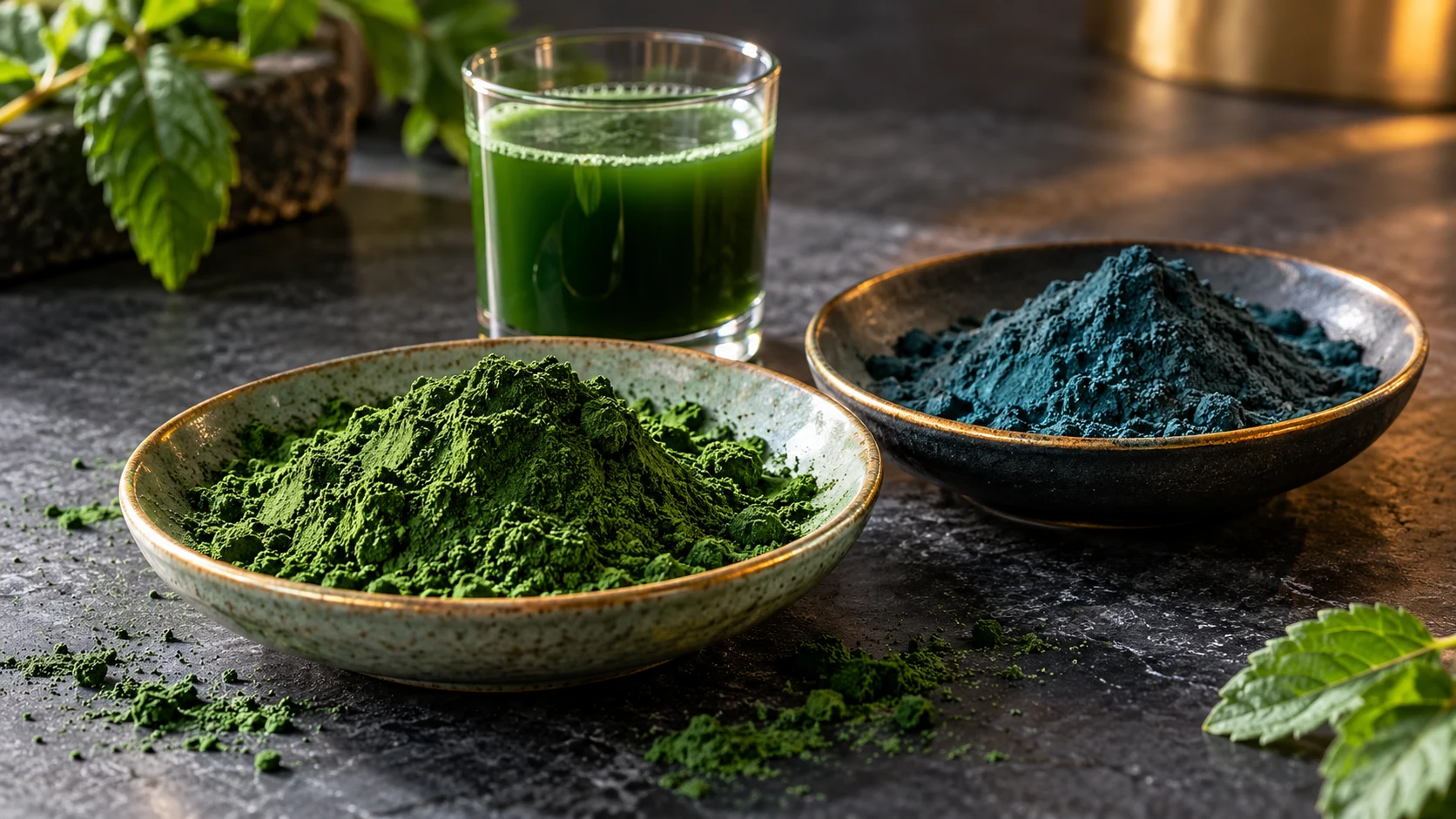
An emerald powder can carry an astonishing amount of expectation. In one conversation it is a protein source; in the next, a mitochondrial upgrade, a detoxifier, or a glimpse of food beyond Earth. Spirulina and chlorella sit at an unusually crowded intersection of nutrition, biotechnology and wellness commerce. Their colours make the story irresistible. Their differences make it worth reporting carefully.
The more useful question is what remains when the visual drama is removed. Which organism is being sold? What has happened to it during processing? How much will someone actually consume? And which result belongs to a controlled human experiment rather than a cell dish, an animal model or a founder’s explanation? Those questions allow genuine possibilities to emerge without requiring every possibility to become a promise.
Our editorial interpretation is that algae deserve a place in the future-food conversation. Their place in an individual health plan is a separate decision. A cultivation experiment, a nutrition label and a clinical trial each illuminate something different. Combining them into one sweeping endorsement makes the evidence less informative precisely when the underlying science becomes interesting.
Two names that should stay separate
Spirulina usually refers to edible cyanobacteria, commonly described as blue-green algae, including organisms classified as Arthrospira. Chlorella is a green microalga. Both can be used as food ingredients, but they are not interchangeable preparations. Whole biomass, disrupted cells, concentrated pigments and purified extracts can have substantially different compositions. A paper studying one cannot automatically validate the others.
This matters particularly for blue spirulina. The bright blue ingredient often marketed under that name is an extract associated with phycocyanin, rather than the full green biomass used in many food and supplement studies. A striking pigment can be a legitimate research subject without inheriting the entire nutritional profile or clinical record of its source organism.
Even within one category, species, growing conditions, drying and extraction can change the intervention. In reporting a result, the noun should therefore be followed by a description: which spirulina, which chlorella, which preparation? The detail sounds less glamorous than “superfood”. It is also the detail that allows a reader to connect a study to an actual purchase.
The protein percentage needs a portion
A label can advertise an impressive proportion of protein while the portion supplies only a small contribution to a meal. Consider a hypothetical powder containing 60% protein by weight. Five grams would provide three grams of protein; fifteen grams would provide nine. These are arithmetic examples, not analyses of a particular brand. The actual serving and composition must come from its label.
The distinction is between concentration and contribution. A concentrated food may be useful, but it does not become a substantial protein serving simply because its percentage is high. Cost comparisons should use grams of protein supplied at a realistic portion, alongside palatability, tolerability and the rest of the diet. Counting tablets obscures that comparison if tablet sizes differ.
A 2024 human crossover experiment compared spirulina, whole-cell chlorella, split-cell chlorella and milk using servings matched for protein. It found different post-meal amino-acid responses. That is a valuable digestion-and-absorption question. An acute amino-acid curve does not establish equivalent long-term muscle growth, and an experimental protein-matched serving should not be confused with a few retail tablets.
What the cholesterol studies actually offer
In a placebo-controlled chlorella trial in adults with mildly raised cholesterol, investigators reported improvements in selected blood-lipid measures over four weeks. The study involved 63 participants. Its attraction is the use of a comparison group and measurable outcomes; its limitation is that a short change in a marker is far removed from observing fewer heart attacks or longer survival.
A spirulina study involving 52 sedentary men with excess body weight examined supplementation with and without an exercise programme. The design explored whether these interventions affected blood lipids over short treatment periods. It should not be turned into an assertion that spirulina performs like exercise, replaces lipid-lowering treatment or produces the same effects in every population.
Positive results also have to share space with less persuasive ones. A National Institutes of Health LiverTox summary describes a placebo-controlled obesity trial in which changes in serum lipids did not differ between groups. That mixed picture is more credible than a catalogue containing only favourable endpoints. Different populations, preparations and study sizes can produce different answers without either study being meaningless.
A liver marker is not a repaired liver
A randomised trial of spirulina-containing sauce in people with fatty liver disease assessed liver enzymes, ultrasound fatty-liver grade and metabolic measurements over eight weeks. It reported favourable changes in some outcomes. The intervention was a specific food preparation in a selected clinical population, not an unrestricted test of all spirulina products in all consumers.
Here the outcome language deserves precision. A liver enzyme is a blood measurement. Ultrasound grading describes an imaging assessment. Neither alone demonstrates that a supplement prevents cirrhosis, reverses fibrosis or improves survival. Those stronger outcomes require their own evidence. This is a reporting distinction, rather than a dismissal of the early findings: the measurements are useful because they define the next questions.
When many outcomes are measured, readers should also ask which was the principal question and how the analysis handled multiple comparisons. A paper may contain several favourable changes and several unchanged measures. Choosing only the favourable ones creates an impression of consistency the experiment itself may not support. A good feature should let both kinds of result remain visible.
Immunity, energy and the language of mechanism
A Korean randomised chlorella study investigated natural-killer-cell activity and immune signalling over eight weeks. Those are biological measurements, not a count of infections prevented. “Immune activity changed” and “people became healthier” are different statements. More immune activity is also too vague a universal objective; a clinical benefit has to be defined rather than assumed.
The same discipline applies to antioxidant and mitochondrial language. Detecting a compound in a food does not show that the intact compound reaches a particular human tissue in a useful amount. Digestion, absorption, metabolism and elimination stand between the ingredient and the proposed destination. A plausible biochemical story can guide an experiment, but cannot substitute for the experiment.
For our reporting, a mechanism becomes more persuasive when the chain is visible: a defined preparation produces measurable exposure, exposure changes a relevant biological process, and that change accompanies a meaningful outcome. Missing links do not prove the idea wrong. They tell us which part of the story remains a hypothesis. That is where curiosity should concentrate.
Detoxification needs an object
“Detox” is an incomplete sentence until someone names the substance, the exposure and the measurement. Is the claim reduced absorption, increased excretion, lower tissue burden or relief of symptoms? A laboratory binding experiment cannot by itself establish clinical removal of a contaminant in people. Nor does a change in an oxidative-stress marker identify the removal of a toxin.
Cancer-related claims require similar care. A small Japanese open-label study explored chlorella preparations and quality of life in women with breast cancer. It did not establish tumour shrinkage or improved survival. Researchers affiliated with a chlorella company were among the authors. Quality of life deserves research in its own right; it should not be repackaged as proof of cancer treatment.
Open-label studies have additional interpretive challenges when outcomes include self-reported feelings: participants know what they receive, and expectations may influence responses. That does not make a person’s experience unreal. It makes a blinded comparison particularly valuable when testing whether an intervention causes that experience. Commercial enthusiasm should make the design more visible, not less.
The space connection is real, and specific
NASA has described a JAXA investigation of spirulina cultivation relevant to future space food systems. A separate NASA account discusses chlorella-related biological research. These are concrete examples of scientific interest under unusual environmental constraints. They do not amount to an endorsement of a retail brand.
The attraction of that research is broader than a capsule. Future food systems must consider production conditions, available resources and nutritional output. Our interpretation is that the engineering questions make algae compelling even if a particular consumer supplement ultimately delivers modest benefits. An organism does not need to reverse ageing to be technologically interesting.
Country names should be handled with the same care. Japanese, Korean and international space investigations show different kinds of activity. They do not establish a global league table of clinical adoption or scientific leadership. A claim that hospitals routinely use a product needs evidence about those hospitals and that product, rather than a map of places where algae have been studied.
Before the promise, the batch
The US Food and Drug Administration documents microcystin contamination risks in blue-green algae products. This is a quality-control issue, not a claim that every product is contaminated. The practical implication is that a natural origin, an organic label or an attractive manufacturing story cannot replace appropriate testing.
A useful supplier conversation begins with identity, preparation and a batch-specific certificate of analysis. Which laboratory performed the work? Which contaminants were assessed? Does the report correspond to the batch being sold? These are purchasing questions rather than a prescription. Someone taking medicines or receiving treatment should bring the actual product label to a qualified clinician or pharmacist.
The next persuasive algae story will join those ordinary details to better human evidence: a reproducible intervention, a clear comparison, enough participants and outcomes that matter beyond a laboratory panel. Until then, spirulina and chlorella remain interesting foods and research subjects with specific, uneven signals. The luxury worth insisting on is clarity: enough detail to distinguish a possibility from a result.
Read beyond the headline.
- 2024 algal and milk protein crossover experiment — primary human study
- Chlorella and serum lipids — primary randomised trial
- Spirulina and exercise lipid trial — primary randomised trial
- LiverTox: Spirulina — official clinical reference
- Spirulina sauce in fatty liver disease — primary randomised trial
- Chlorella and immune markers — primary randomised trial
- Chlorella and breast cancer quality of life — primary open-label trial
- Nutrition research aboard space station — official NASA
- Biological research aboard space station — official NASA
- Algae products and microcystins — official FDA
Original sources and their evidence roles are listed above. Supplier reports are identified separately from independent research. Sources were checked for this expanded editorial edition; access limitations are recorded in the feature audit.