By Youtopia Life editorial · Research checked 3 October 2026 · AI-assisted research and writing; no independent clinical review
These are nutrient-rich foods with interesting human studies. The evidence is stronger for composition and selected short-term measurements than for broad promises about detoxification, cancer or longevity. Combining them is a testable idea, not a demonstrated universal upgrade.
The discovery conversation
Catharine Arnston founded ENERGYbits, a company selling algae products. Dave Asprey’s recent conversation with her explores mitochondria, phycocyanin, antioxidant pathways, protein and detoxification. We use the episode as a reporting lead and disclose the commercial context. Founder experience and laboratory explanations do not replace trials of the actual product.
| Question | Spirulina | Chlorella |
|---|---|---|
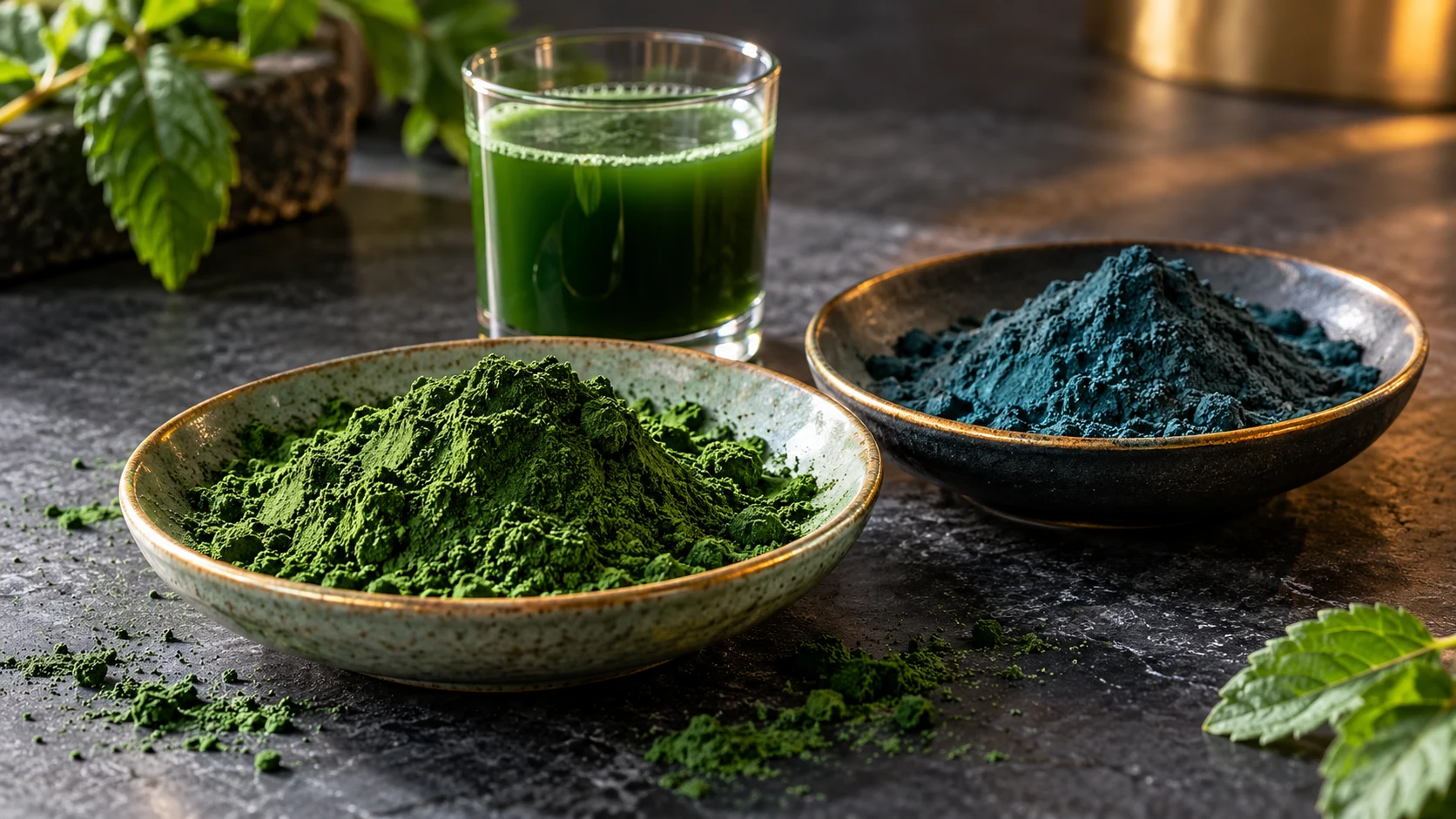
| What is it? | Edible cyanobacteria, commonly called blue-green algae; often Arthrospira species. | Green, single-celled microalgae with a more resistant cell wall. |
| What makes it interesting? | Protein and blue phycocyanin pigment; food and biochemical research. | Protein, pigments and micronutrients; processing affects nutrient availability. |
| What must be distinguished? | Whole spirulina and isolated blue extract are different preparations. | Whole-cell, disrupted-cell and extracts are different interventions. |
| What is not established? | Broad clinical promises about brain rejuvenation or longer life. | A general-purpose detox or cancer-treatment benefit. |
From a food to a cell: where the leap occurs
Food proteins are digested into peptides and amino acids before absorption. Finding an antioxidant compound or enzyme in a food does not show that eating it delivers the intact molecule to a person’s mitochondria. Mechanistic hypotheses need evidence of absorption, a relevant tissue effect and a meaningful human outcome. An oxidative-stress marker alone does not measure how long or well someone will live.
Protein: compare portions, not slogans
In a 2024 crossover study, ten healthy young adults consumed preparations providing an equal 20 g of protein from milk, spirulina or whole/split-cell chlorella. The amino-acid responses differed; spirulina and milk produced greater availability than chlorella, with only small improvements from splitting chlorella cells. This is a small acute experiment, not evidence of equivalent long-term muscle growth.
High protein concentration by dry weight does not mean a few tablets replace a meal. For illustration, a hypothetical 5 g serving labelled 60% protein supplies 3 g protein; a hypothetical 15 g serving supplies 9 g. Check the actual label. “The biggest form of protein” needs a defined comparison: percentage, absorbed amino acids, serving size or nutritional outcomes.
What have human studies measured?
A four-week placebo-controlled chlorella study in 63 adults with mildly raised cholesterol reported changes in some lipid markers. The short duration and selected population limit what it says about cardiovascular events or general use. Korean researchers also studied immune-cell activity over eight weeks; a change in natural-killer-cell activity does not demonstrate fewer infections or protection against cancer.
There are further trials investigating metabolic, exercise and inflammatory outcomes. We will assess each intervention separately rather than combine all reported signals into a promise of benefits “in everything”.
Does the combination work in synergy?
Different nutrient profiles can make a combination plausible. Demonstrating synergy requires a comparison of spirulina alone, chlorella alone, both together and a suitable control, with a predefined outcome. Our initial search did not identify robust evidence establishing a general clinical synergy. This is an open research question; we have not proven that no combination studies exist.
NASA, hospitals and countries: make the claim specific
Space research is verified. NASA reports a JAXA experiment exploring thin-film spirulina cultivation for future food and oxygen production. NASA also reports chlorella-related space protein research. These are concrete food-system investigations, not NASA endorsement of a retail supplement or proof astronauts routinely take an advertised brand.
Cancer treatment claims need a separate standard. A Japanese open-label randomised study explored chlorella and an extract in people with breast cancer, measuring quality of life. This does not establish tumour response or survival benefit, and does not verify routine adoption by cancer hospitals. Anyone receiving cancer treatment should review supplements with their oncology team.
A research map is more useful than a league table. Japan provides space-cultivation and breast-cancer quality-of-life examples; South Korea provides lipid and immune-marker trials; NASA documents US and international space-food work. These examples do not establish which country leads production, research quality or clinical adoption. We will need comparable data before making that ranking.
Quality checks before a product story
Ask for species identity, preparation, actual serving size and batch-specific contaminant testing. The FDA documents microcystin contamination risks in blue-green algae products; a “natural” or “organic” description is not a toxin test. Heavy-metal and microbial testing should also be examined before recommending a supplier. Discuss suitability with a doctor or pharmacist, especially with medicines or ongoing treatment.
The next rabbit holes
- Whole spirulina versus blue phycocyanin extracts: what has actually been trialled?
- Processing, digestibility and protein contribution at real serving sizes.
- Detox claims: identify the toxin, exposure, measured endpoint and controlled human evidence.
- Combination trials and whether effects exceed either ingredient alone.
- Research funding, product-specific evidence and independently verified certificates of analysis.
For educational purposes only; not personal medical advice, diagnosis or a treatment plan. Always read the label and follow directions for use. Check with your doctor or pharmacist before starting supplements or changing medicines, particularly during pregnancy, for children, or if you have a medical condition. Do not stop prescribed treatment because of an article.
Follow the sources
- Discovery source: Arnston / Asprey conversation, commercial context disclosed
- 2024 acute protein comparison, primary human study
- 2014 chlorella lipid trial
- 2012 chlorella immune-marker trial, Korea
- 2014 breast-cancer quality-of-life study, Japan
- NASA: JAXA Space Surface Spirulina research
- NASA: chlorella protein and microgravity investigation
- FDA: blue-green algae products and microcystins
No paid placement or affiliate purchase links in this article. A source link is a research trail, not an endorsement. Our editorial standards and corrections policy.